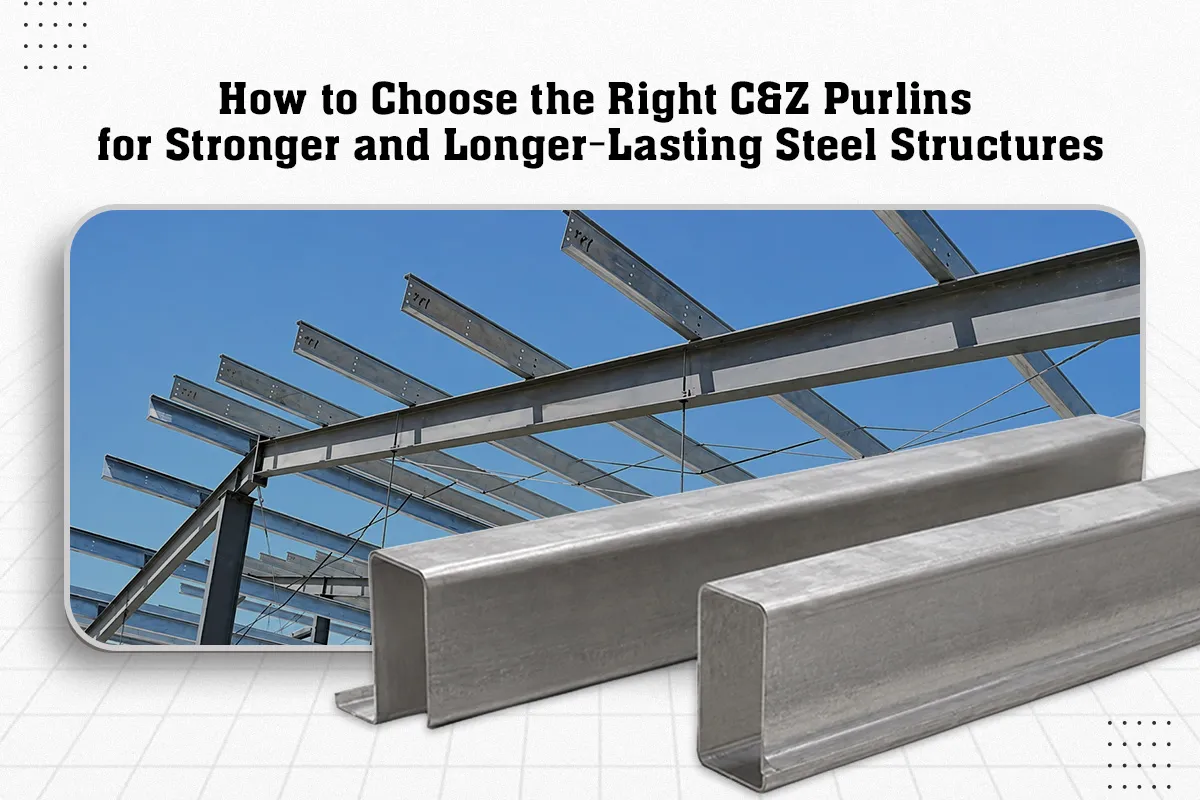
The most expensive mistakes in steel buildings are the smallest parts. Just ask anyone who’s had to fix a sagging shed roof, or replace rusted framing after a few monsoons. Nine times out of ten the trouble began with the purlins, the horizontal steel members that carried the roof sheets and held the whole covering together.
Choose C&Z Purlins well and you forget about them for decades. Choose them poorly and every rainy season reminds you. The good news is that choosing well is not complicated once you know what the letters C and Z actually mean, and what to check before placing your order.
What Are C&Z Purlins in a Steel Building?
Picture the skeleton of a factory shed. Big steel columns and beams form the main frame. But roof sheets cannot be fixed straight onto beams that sit metres apart. Something must bridge the gap and give the sheets a regular line of support.
That something is the purlin. C&Z Purlins are the two most common shapes, named simply after the letters they resemble when you look at their cut end. They run across the main frames, usually a metre or so apart, and the roof and wall sheets screw onto them.
Small parts, big job. Every kilo of wind pressure and every drop of rain load on the roof passes through the purlins on its way to the main structure.
What Is the Difference Between C Purlin and Z Purlin?
The shape decides the behaviour, and this is simpler than it sounds.
A C Purlin looks like the letter C. It has a flat back that sits neatly against a surface, which makes it the easy choice for wall framing, door and window openings, and simple single-span roofs where one purlin runs from support to support.
A Z Purlin looks like the letter Z, with its two flanges pointing in opposite directions. That small twist gives it a clever ability: one Z purlin can overlap and nest into the next one over a support. The joined purlins behave like one continuous member running the length of the building, which makes the whole roof line stronger for the same weight of steel.
The simple rule of thumb: C for walls and short spans, Z for long continuous roof runs. Your structural engineer will confirm the right choice for your spans and loads.
Why Are Cold Formed Purlins Lighter Yet Strong?
Here is a fact that surprises many first-time buyers. Purlins are not cast or heated into shape. They are made by passing galvanised steel strips through rollers at room temperature, which is why they are called cold formed purlins.
Cold rolling serves two purposes. It is as strong as steel, and can be shaped very accurately into thin sections. What you get is a member that weighs a fraction of a conventional hot-rolled section, but carries roof loads with equal confidence. The lighter purlins mean a lighter frame, easier handling on site and lower transportation and erection costs. The savings are all quiet, in the whole building.
What Should You Check Before Buying Steel Purlins?
Four things separate purlins that last decades from purlins that fail early.
The steel itself. Ask for the grade and the test certificate. Good steel purlins start as high-tensile galvanised steel, not whatever coil was cheapest that week.
The coating. Galvanising thickness decides how the purlin handles moisture over the years. This matters double near the coast or around chemical plants.
The accuracy. Punched holes should line up with your frame drawings exactly. Site drilling weakens sections and slows erection.
The engineering support. Span, load and spacing must be calculated, not guessed. A reliable Purlin Manufacturer India buyers can trust will give you load tables and technical help, not just a rate per kilo.
This is the standard LCP Building Products has held for over 30 years. Our LCP PURLIN & GIRT range is roll-formed in-house on precision machinery, supported by ISO 9001:2015, ISO 14001:2015 and ISO 45001:2018 certifications, and an engineering team that helps you match section, gauge and spacing to your actual building rather than a generic catalogue answer.
How Do Purlins Affect the Life of the Whole Building?
Think of purlins as the link in the middle of a chain. The structural steel frame may be massive and the roof sheets premium, but everything between them depends on the purlins holding firm.
Purlins are undersized. Therefore, roofs sag and sheets loosen at the screws. If the coating is bad, rust starts at the Purlin line. Mispunched holes force connections that stress the frame from day one. None of these problems appear when you purchase it. They all appear two or three monsoons later when the cost of fixing them is many times the money saved on cheaper purlins.
Spend carefully here, once, and the rest of the building rewards you for it.
FAQs
Can I use C purlins and Z purlins in the same building?
Yes, many buildings use Z purlins on the roof and C purlins for wall framing.
What are the dimensions of purlins?
Standard depths and thicknesses are load and span dependent. Post your drawings and the manufacturer will recommend the proper section.
If the purlins are galvanized do I need to paint them?
Generally no. Under normal conditions, the zinc coating protects the steel .
How far apart are purlins fixed?
Spacing depends on the roof sheet profile and design loads, typically decided by the structural engineer.
Does LCP supply purlins for small projects?
Yes, our range serves everything from small workshops to large industrial sheds.