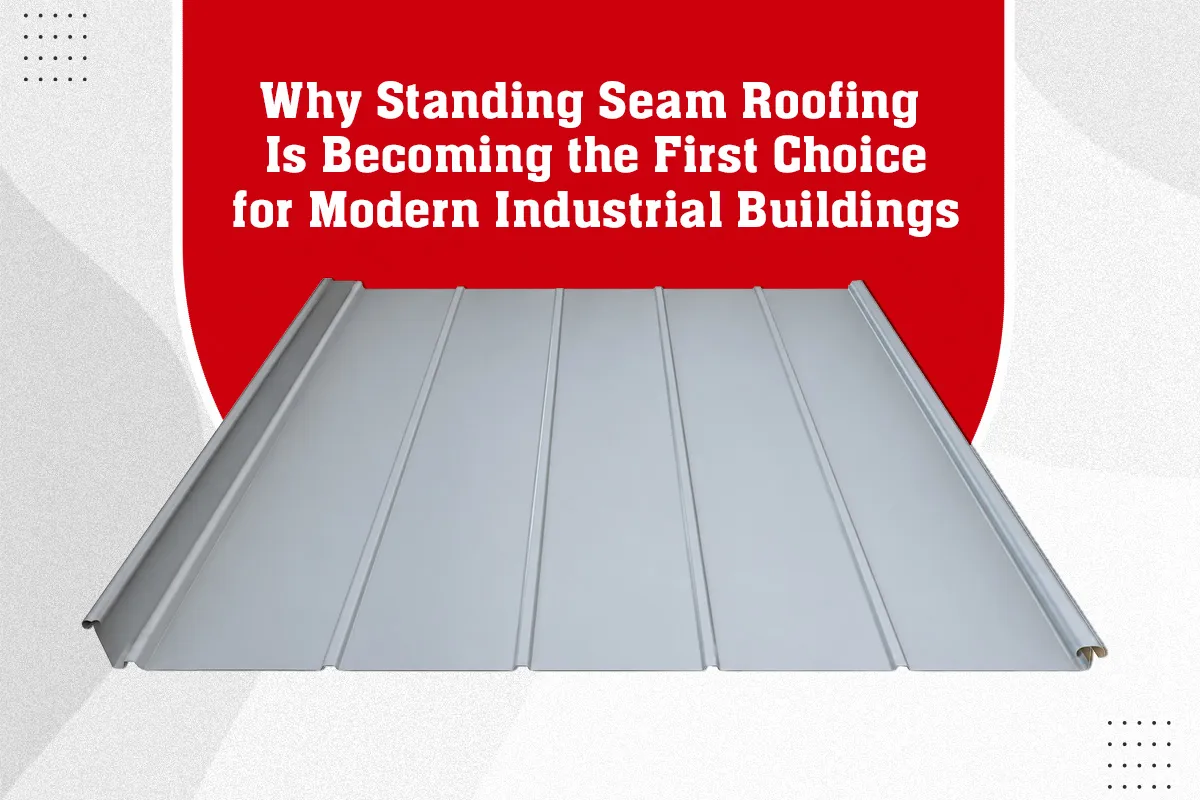
Why are so many factories, warehouses and commercial buildings across India switching to standing seam roofing? The reason comes down to three things: it does not leak, it lasts for decades, and it looks far better than traditional bolted sheets. As industrial construction grows more demanding, this roofing method has quietly become the default choice for serious builders.
At LCP Building Products, we have manufactured standing seam roofing profiles for over 30 years, and we have watched this shift happen project by project. Here is what makes this system different, and why it might be right for your next build.
What Is Standing Seam Roofing?
A standing seam roof system is a metal roofing system where the panels join along raised seams that sit above the water line. The panels lock into each other, and the fasteners stay hidden beneath the surface.
The last point is the most important of all. Traditional roofing leaves hundreds of punctures in the sheet with screws. Every hole is a future leak, just waiting for its moment. In concealed fix roofing there are no exposed penetrations whatsoever. There is just no place for water to enter.
Why Are Industrial Buildings Moving to Standing Seam Roofing?
Leak Protection by Standing Seam Roofing
Traditional roofs fail at the fasteners as the washcloths age and the sheets stretch. This weakness is eliminated completely by a standing seam design. We test our profiles for static water penetration per ASTM E 331, so you know what you’re getting, not just what you’re promised.
Room for Thermal Movement
The metal heats up during the day and then cools at night. This constant motion will gradually loosen any exposed screws. Standing seam panels are intended to slide within their clips so the roof can move without exerting any pressure on any fixing point. This is important for large industrial roofing spans in Indian climates.
Long Service Life, Low Maintenance
If installed correctly, standing seam metal roofs can last decades with just regular inspections. No screws to tighten. No wash clothes to swap out. This means less downtime and lower life costs for factory owners.
Clean, Modern Appearance
There are no visible fasteners and the roof has clean straight lines from ridge to eave. Architects are specifying it more and more for offices, airports and showrooms where the roof is part of the visual identity of the building.
Which Material Should You Choose?
| Material | Best For | Key Advantage |
| Steel (zinc-aluminium coated) | Factories, warehouses | Strength and cost-efficiency |
| Aluminium standing seam | Coastal and corrosive zones | Excellent corrosion resistance, lightweight |
| Titanium zinc (Zintek®) | Premium architectural facades | Self-healing patina, 80+ year lifespan |
We are the only roofing manufacturer in India with in-house machinery to roll-form profiles in all three metals: steel, aluminium and titanium zinc. Whatever your project demands, we produce it under one roof, quite literally.
Common Mistakes to Avoid with Standing Seam Roofs
- Panel thickness selection based on price rather than span and windload
- Employing trained standing seam installers rather than general contractors
- Not allowing for thermal movement in very long runs of panels
- Combining incompatible metals which can cause galvanic corrosion
Getting the engineering right at the design stage costs far less than fixing a roof later. Our team supports projects from design through installation for exactly this reason.
Is It Worth the Higher Initial Cost?
Yes, and the arithmetic is straightforward. A standing seam roof costs more per square metre upfront than basic corrugated sheeting. But once you factor in decades of leak-free service, minimal maintenance and no premature replacement, it usually works out as the cheaper roof over the building’s life. Among roofing systems India offers today, few match this long-term value.
FAQs
What is the difference between standing seam and screw fixed roofs?
On screw-fixed roofs, fasteners pass through the sheets and are exposed. Standing seam panels interlock with hidden clips and do not provide any openings for water.
How long does a standing seam roof last?
Depending on the material, anywhere from 40 years for coated steel to 80+ years for titanium zinc, with proper installation.
Is standing seam roofing suitable for solar panels?
Yes. Solar mounting clamps attach directly to the seams without drilling into the roof, keeping the surface watertight. We also manufacture solar module mounting structures.
Can standing seam roofs handle heavy rain?
Absolutely. The raised seams sit above the water flow line, and our profiles pass the ASTM E 331 water penetration test.
Build a Roof That Outlasts the Building Around It
If you are planning an industrial or architectural project, talk to our engineering team before you finalise the roof. Call us at 044 2989 2772 or write to marketing@lcpgroup.asia, and we will help you choose the right profile, material and design for your site.