Keyword | Type | Total | Subhead | FAQ | Body |
Trapezoidal Roofing | Primary | 6 | 1 | 1 | 4 |
Trapezoidal Profile Roofing | Secondary | 2 | 0 | 0 | 2 |
Trapezoidal Roofing Solutions | Secondary | 2 | 0 | 1 | 1 |
Industrial Trapezoidal Roofing | Secondary | 2 | 1 | 0 | 1 |
Secondary total | 6 | 1 | 1 | 4 |
How to Choose the Right Trapezoidal Roofing Sheet Thickness and Profile
Hold a sheet of paper by one edge and it flops over. Fold the same sheet into pleats like a fan, and it stays out straight. A trapezoidal sheet works on the same idea: it is a flat strip of metal folded into ribs, and the folds give it much of its stiffness.
Engineers use something called the second moment of area to measure how a sheet’s shape affects its stiffness. The higher this value, the less the sheet tends to sag (called deflection by engineers). So when choosing trapezoidal roofing, you need to match the sheet thickness and rib profile to the span and the loads it will carry. Simply going for the thickest sheet doesn’t necessarily mean you’re making the right choice.
What Makes a Trapezoidal Sheet Strong?
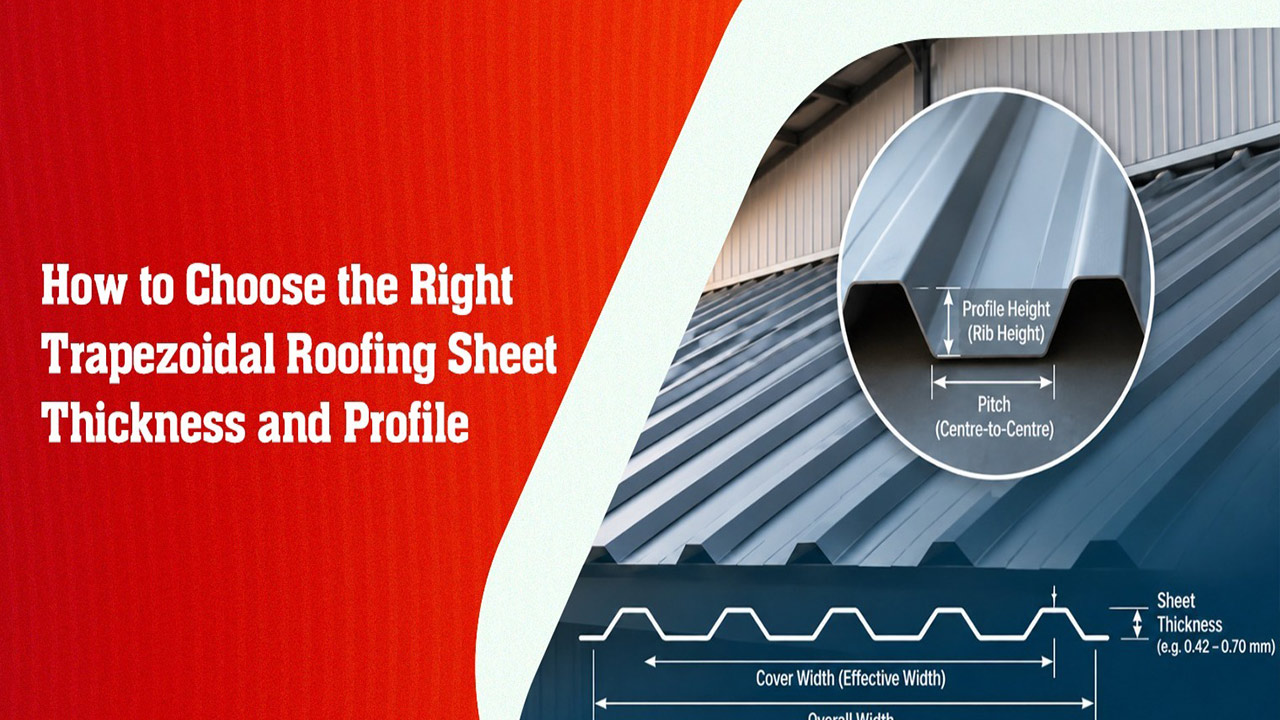
Picture your sheet as a small bridge between two purlins, which are the beams under the roof. Three things make that bridge stiffer: thicker metal, taller ribs and more pans. The pans are the flat strips between the ribs. In the study discussed below, the width of the ribs mattered much less. This is a finding of one study, not a general rule.
There is a limit, though. A tall, very slender fold can crumple sideways before the metal itself gives way, in the same way a drinks can dents when it is squeezed on its side.
What Thickness Suits Industrial Trapezoidal Roofing?
According to a 2016 dissertation from the University of the Witwatersrand, sheet thickness “could range from 0.3 to 0.8 mm depending on the type, size and number of spans”. Even the top of that range is under a millimetre. The study looked at inverted box rib (IBR) sheeting, one form of trapezoidal sheet, made of steel with a galvanised zinc or Zincalume coating. It does not say whether the thickness is the base metal thickness or the total coated thickness, and Indian buyers use both terms, so always check which one a quote means. Treat the range as a guide for steel sheet and not a rule for every profile or metal.
A small workshop or house extension usually has short spans and light loads, so the lower end of the range often suits it. Industrial trapezoidal roofing usually has longer spans and higher design loads, which is why the span and loads should be checked before any thickness is chosen.
How Tall Should the Ribs Be?
Taller ribs make a sheet much stiffer, but they cost more metal. In the study, doubling the rib height from 37 mm to 74 mm cut the sag at the middle of the span by about 80%. The flat strip needed to form the sheet grew by roughly 30%.
So the answer is a balance and not the taller the better. For a trapezoidal profile roofing sheet, a rib that is too tall and slender brings back the crumpling problem.
The table puts the three factors side by side. The figures come from one study of IBR sheeting on purlins 2200 mm apart, so use them to see the direction of each effect and not as design values.
Sheet thickness | Stiffness rose as thickness rose | The range studied was 0.3 to 0.8 mm |
Rib height | Doubling it from 37 mm to 74 mm cut sag by about 80% | The flat strip needed grew by roughly 30% |
Rib width | Little effect on stiffness | About 23 mm was suggested, to save metal |
Pans count as well, since the study found stiffness rising as pans were added. When two quotes offer the same thickness, ask how many pans each trapezoidal profile roofing sheet has.
Which Loads Decide the Choice?
Wind does not only push on a roof. It can also pull upwards, and in the study this pull, called uplift, was the most critical load, because it squeezes the pans and they can buckle. The study also tested a weight at the middle of the span, standing in for a person walking on the sheet. Snow was left out.
Picture two quotes for the same roof, one with a thicker sheet and one with taller ribs. This is an illustration, not a real case, but it shows the point: you cannot judge them fairly until you know the thickness, the rib height and the purlin spacing each supplier has assumed. Any trapezoidal roofing enquiry should also state the wind uplift and state the design wind uplift (IS 875 Part 3) and the imposed roof loads (IS 875 Part 2).
Roofing Profiles From Our Own Machinery
LCP has been in roofing for more than 40 years, and our ISO 9001:2015 certification covers how we work. In Chennai, we roll roofing and cladding profiles, purlins and top hats on our own machinery. Our range includes LYCOR HI-RIB® and standing seam profiles.
We supply trapezoidal roofing solutions in steel and aluminium, so the metal can be matched to your project.
FAQs
What Finishes Are Available With Your Trapezoidal Roofing Solutions?
Our steel sheets are made from zinc-aluminium coated steel with a minimum coating mass of 150 g/m², and they are also available pre-painted in a range of colours. Bare galvanised steel is available on enquiry. Our aluminium sheets come in mill, painted and stucco embossed finishes. On painted aluminium, a conversion coating and a primer of about 5 μm on each side sit under a 70% PVDF finish coat of about 20 μm on the weather side, and a light grey coat of about 5 μm protects the back. A micrometre is a thousandth of a millimetre, so these layers are far thinner than the sheet itself.
Does the metal change the thickness I need?
Yes. Two sheets with the same shape and thickness can flex differently if they are made from different metals. How stiff a metal is gets measured as its modulus of elasticity, which is 69 GPa for our aluminium alloys 3004 and 3105. Steel is about 200 GPa, roughly three times as stiff, so an aluminium sheet generally needs more thickness or taller ribs to match the stiffness of a steel sheet of the same shape.
Which Indian Standards Apply to Coated Steel Trapezoidal Sheets?
Our trapezoidal profile uses zinc-aluminium alloy coated steel made to IS 15961, and the paint on pre-painted sheet follows IS 15965. IS 14246:2024 covers pre-painted galvanised (zinc-coated) steel only, so it applies only if a sheet is galvanised. Check that your quotation names the standard for the coating and for the paint, and that it matches the sheet you are buying.
What Does a Deflection Limit of Span/200 Mean?
It means the sheet may sag by no more than one 200th of the distance between its supports. In the study the purlins were 2200 mm apart, so the allowed sag at the middle was 11 mm. The study took the span/200 limit from SAISC (2013), a South African steel reference, so it is not an Indian code limit. Change the purlin spacing and the allowance changes too, which is why spacing belongs in every enquiry, and your designer should confirm the limit that applies to your roof.
To choose the right thickness and profile for your project, share your purlin spacing and design loads with the LCP India team.
Sources: A Parametric Study on IBR Sheeting Supported by Purlins, M. S. Mlasi, University of the Witwatersrand (2016); IS 14246:2024, Continuously Pre-Painted Galvanized Steel Sheets and Strips, Bureau of Indian Standards (February 2024); LCP India website and product data.
Explore Our latest Blogs :
Roofing Accessories Checklist: Essential Components for a Leak-Free and Durable Roof
How to Choose the Right C&Z Purlins for Stronger and Longer-Lasting Steel Structures
Metal Decking Explained: Everything Builders Need to Know Before Starting a Project
Why Standing Seam Roofing Is Becoming the First Choice for Modern Industrial Buildings
Leave A Comment