Keyword | Type | Total | Subhead | FAQ | Body |
Zinc Titanium Standing Seam | Primary | 6 | 1 | 1 | 4 |
Zinc Titanium Standing Seam Panels | Secondary | 2 | 1 | 1 | 0 |
Zinc Titanium Roof Cladding | Secondary | 2 | 0 | 0 | 2 |
Zinc Titanium Roofing System | Secondary | 2 | 0 | 0 | 2 |
Secondary total | 6 | 1 | 1 | 4 |
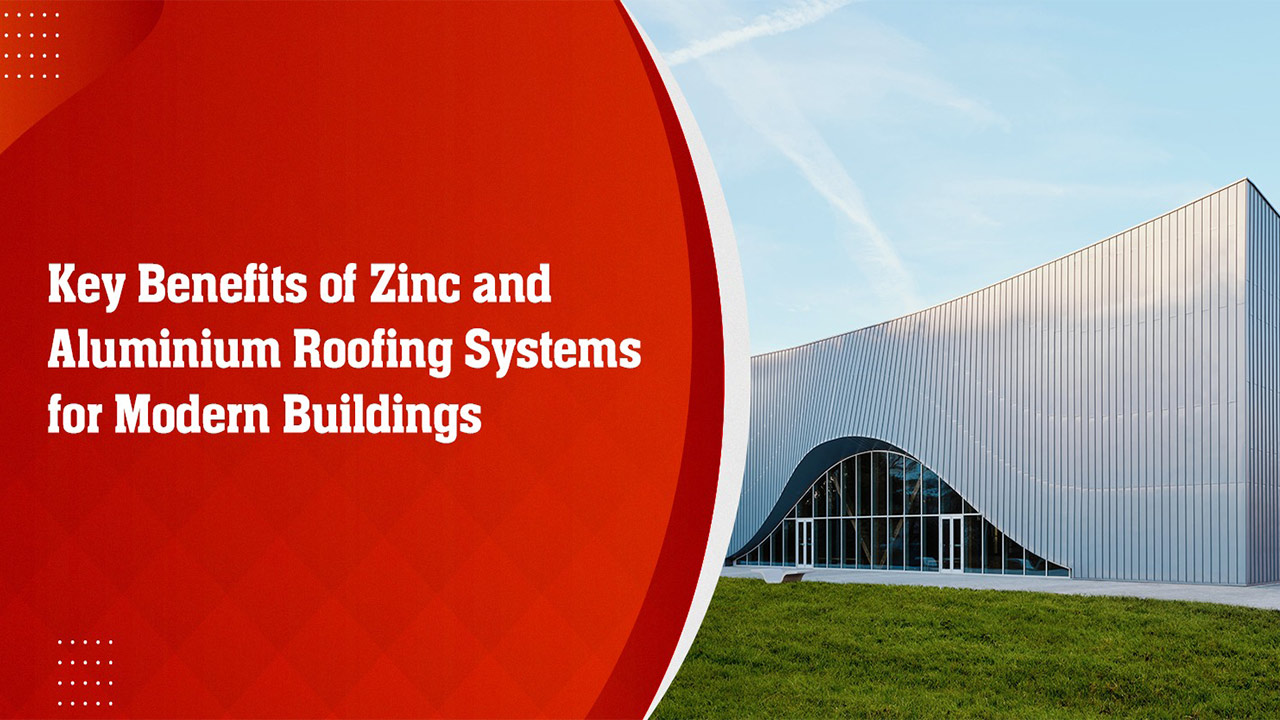
Key Benefits of Zinc and Aluminium Roofing Systems for Modern Buildings
Titanium zinc and aluminium are two of the metals designers choose when a roof or facade has to look sharp and last. Both can be rolled into standing seam profiles, yet they are different materials with different strengths. Each brings its own benefits to a modern building, so the useful question is which benefits matter most for a particular project. LCP Building Products forms both metals into standing seam profiles, so the differences are set out below from a supplier’s point of view.
A zinc titanium standing seam roof is made from a zinc-copper-titanium alloy, which is the material covered by the European standard EN 988. Once the alloys are clear, five points separate the two metals: how each surface protects itself, how the metal is finished, how much it weighs, how it moves with temperature and how it is supported on the roof.
What Is Titanium Zinc Made Of?
Titanium zinc is a zinc-copper-titanium alloy, and you will also see it written as zinc titanium. EN 988 treats it as a rolled flat product for building, in the form of strip, sheet or cut length. The standard covers thicknesses from 0.6 mm to 1.0 mm and widths from 100 mm to 1000 mm.
A zinc titanium roofing system starts with this flat material and ends with formed, seamed panels fixed to the structure.
How Zinc and Aluminium Protects Itself
Titanium zinc resists corrosion well in air. When it is exposed to the weather, its surface covers itself with a layer of basic zinc carbonate, a natural protective layer that stays stable over time.
Aluminium works differently, because a self-healing passive oxide layer forms on its surface. On painted aluminium, protection comes mainly from the PVDF coat. The aluminium alloys we use go into roofing and cladding products.
Titanium Zinc and Aluminium Side by Side
Point | Titanium zinc | Aluminium |
Alloy | Zinc-copper-titanium alloy, as covered by EN 988 | Aluminium alloy 3004 or 3105 |
Surface protection | Basic zinc carbonate layer that forms in the weather | Self-healing oxide layer, with painted aluminium protected mainly by its PVDF coat |
Finish | Natural or pre-weathered | Mill, painted or stucco embossed |
Support | Fully supported on a continuous substrate (EN 14783, the standard for fully supported metal sheets) | Clipped to purlins |
Density | 7.14 g/cm³ | 2.72 g/cm³ |
Thermal expansion | 22 × 10⁻⁶ per °C parallel to rolling, 17 × 10⁻⁶ per °C across it | 23.9 × 10⁻⁶ per °C |
How Zinc Titanium Standing Seam Panels Suit Modern Buildings
A standing seam roof joins its panels with raised seams, and the clips that hold the panels to the roof structure sit inside those seams. No fixings show on the surface, which leaves clean, unbroken lines. A zinc titanium standing seam roof delivers this look in a material that develops its own protective patina over time.
For walls, we also supply zinc-titanium facades in flat-lock panels. When comparing suppliers, ask whether the profile has been tested to ASTM E 331, the static water penetration test, which checks how a panel resists water under pressure.
How Do Finish, Weight and Movement Compare?
Start with the finish the design needs. Painted aluminium comes in a standard RAL colour range, with custom colours on request. If the design calls for zinc titanium roof cladding instead, the Italian titanium zinc we supply, Zintek®, comes in natural and pre-weathered finishes.
Then compare weight and movement on the same basis. Our aluminium alloys, 3004 and 3105, have a density of 2.72 g/cm³ and a thermal expansion of 23.9 × 10⁻⁶ per °C. Titanium zinc has a density of 7.14 g/cm³ and a thermal expansion of 22 × 10⁻⁶ per °C parallel to rolling and 17 × 10⁻⁶ per °C across it. For a designer, that means a zinc titanium standing seam roof puts about 2.6 times the weight of metal on the structure that an aluminium roof of the same sheet thickness does, while both metals expand by similar amounts for each degree of temperature change. Alloy 3004 in the H42 temper has a proof strength of 130 MPa and a tensile strength of 185 to 240 MPa. Titanium zinc to EN 988 has a minimum proof strength of 100 MPa and a minimum tensile strength of 150 MPa.
Key Benefits of Zinc and Aluminium Metal
Each metal has clear benefits, and the right choice depends on what the building needs.
- Lighter structure (aluminium): Aluminium has a density of 2.72 g/cm³ against 7.14 g/cm³ for titanium zinc, so it puts less load on the structure.
- Natural patina (titanium zinc): Natural titanium zinc is a glossy grey that weathers to a grey slate appearance, and the basic zinc carbonate layer that forms protects the metal beneath.
- Colour choice: Painted aluminium comes in the standard RAL range with custom colours on request, and titanium zinc is available in natural and pre-weathered finishes.
- Roof build-up: Titanium zinc is laid fully supported on a continuous substrate, while aluminium standing seam is typically clipped to purlins.
Steel, Aluminium and Titanium Zinc, Shaped Under One Roof
At LCP Building Products in Chennai, we produce profiles in steel, aluminium and titanium zinc on our own machinery. We supply Zintek®, Italian titanium zinc made to EN 988 from zinc to EN 1179.
That lets us supply a zinc titanium roofing system with standing seam profiles for roofs, along with zinc titanium roof cladding and flat-lock facade panels. Where a project calls for aluminium, steel or zinc titanium standing seam profiles, we shape them in the same place. To discuss titanium zinc or aluminium standing seam for your project, speak to the LCP India team.
FAQs
Can Zinc Titanium Standing Seam Panels Be Used on Walls?
Yes, standing seam is used on both roofs and walls. For walls we also supply zinc-titanium facades in flat-lock panels, where the panels are folded and locked flat to each other instead of forming a raised seam. Standing seam gives strong vertical lines, while flat-lock gives a flatter, more uniform surface, so the choice depends on the look the design needs.
How Do You Finish Painted Aluminum?
Painted aluminium begins with a corrosion-resistant conversion coating as pretreatment. A universal corrosion-inhibitive primer of about 5 μm follows on each side. The weather side then takes a 70% PVDF finish coat of about 20 μm, made with high-performance pigments. The back carries a light grey coat of about 5 μm.
Which Standard Should I Check for Titanium Zinc?
EN 988 sets out the requirements for rolled flat products for buildings made from zinc-copper-titanium alloy. It covers strip, sheet and cut length only, and it does not cover formed or shaped products. In plain terms, the standard describes the sheet, and the profiling that follows is a separate step.
How Are Titanium Zinc and Aluminium Profiles Joined?
On the roof, panels join through their raised seams. Where welding is used, aluminium alloys 3004 and 3105 can be welded by MIG, TIG, laser and high-frequency methods, and they melt between 630 and 655°C. Titanium zinc can be soldered with a traditional lead and tin solder, or welded with TIG or induction methods, and it melts at 419°C. Where screws or nails are used with titanium zinc, aluminium, galvanised steel or stainless steel is preferred, because copper and brass can cause electrochemical corrosion.
To discuss titanium zinc or aluminium standing seam for your project, speak to the LCP India team.
Sources: EN 988:1996 (adopted as SIST EN 988:1998), Zinc and zinc alloys, specifications for rolled flat products for building (iTeh Standards); Yang et al., “Light, strong, and stable nanoporous aluminum with native oxide shell”, Science Advances (2021); Zintek, Technical file of rolled zinc-titanium Zintek® products (zintek.it); LCP India website and product data.
Explore Our Latest Blogs
Roofing Accessories Checklist: Essential Components for a Leak-Free and Durable Roof
How to Choose the Right C&Z Purlins for Stronger and Longer-Lasting Steel Structures
Metal Decking Explained: Everything Builders Need to Know Before Starting a Project
Why Standing Seam Roofing Is Becoming the First Choice for Modern Industrial Buildings
Leave A Comment