
Look at the entrance of a well-designed showroom, hotel or office building, and notice the roof edge. On many of the most attractive ones, the roofing does not stop at a sharp, flat line. It curves gently downwards, rolling over the edge like a wave frozen in steel. That smooth curved edge has a name in the roofing trade, and choosing it is one of the simplest ways to lift an ordinary commercial building into a memorable one.
The curve is not only about looks. The bull nose profile solves practical problems at the most vulnerable part of any roof, the edge, which is exactly why architects keep specifying it for verandahs, walkways, canopies and building fronts.
What Is a Bull Nose Profile in Roofing?
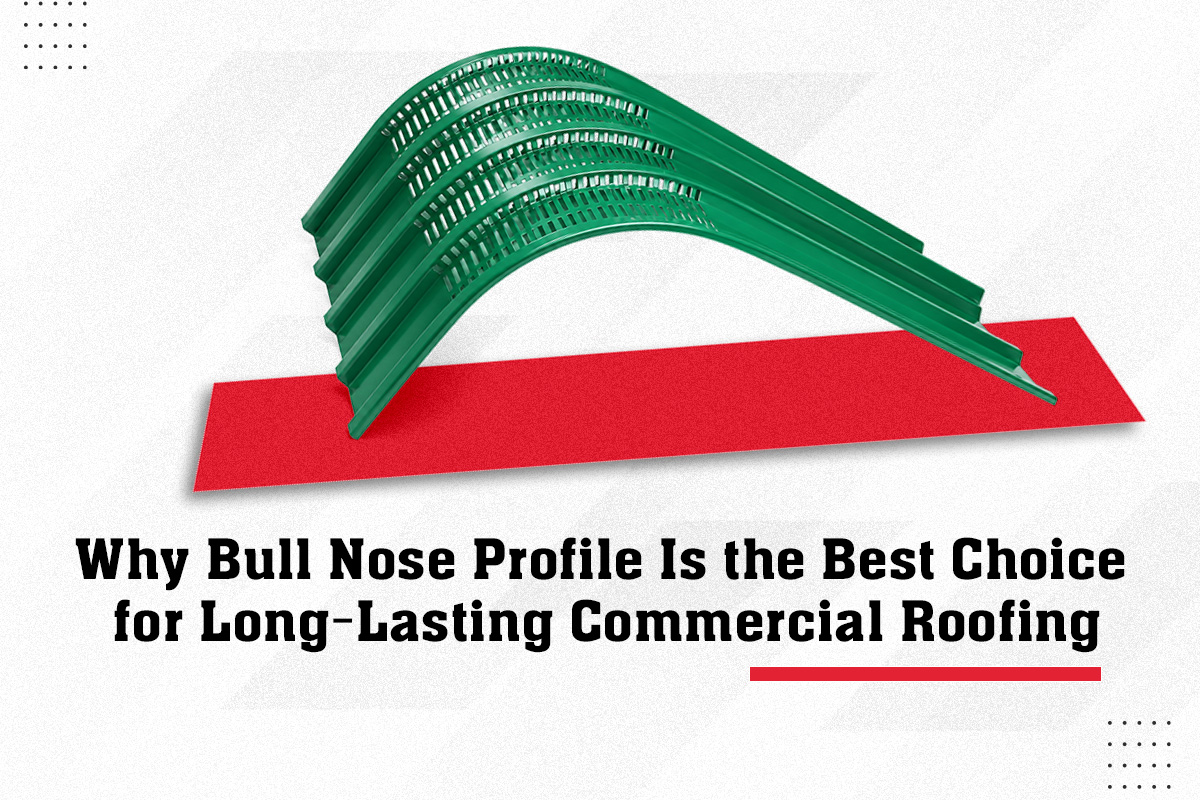
A Bull Nose Profile is a roofing sheet curved smoothly at its end, usually where the roof meets the eave or covers a verandah. Instead of the sheet ending in a straight, exposed edge, it bends over in a rounded shape, the way a bull’s nose curves, which is where the name comes from.
The curve is formed in the sheet itself during manufacturing, on machines built for precision curving. So the roof and its curved edge are one continuous piece of steel, not two parts joined at an angle. That single detail is the source of most of its advantages.
Why is the roof edge so important?
Roofs fail at the edge first. Wind clings hardest to edges and corners. Rain blown at an angle pounds the opening where a flat sheet ends. Any slight waviness or rust line is visible to anyone walking in, Sharp edges also catch the eye.
Bull Nose Roofing profile closes these weak points in one go. The curved edge has no flat lip for the wind to catch and raise. Water runs off the curve smoothly, not being driven back under the sheet. The curve is factory-formed and continuous so the finished edge remains crisp and uniform along the entire building line, year after year.
Where Is Bull Nose Roofing Used in Commercial Buildings?
Walk through any commercial area and you will spot the curve more often than you expect:
- Verandahs and covered walkways around shops and offices
- Entrance canopies of hotels, hospitals and showrooms
- Petrol station and mall forecourt coverings
- Balcony and window shade roofing on larger buildings
- Long walkway coverings in schools, campuses and factories
How Does Bull Nose Fit Into Modern Architectural Roofing?
Commercial buildings today compete on appearance. Clients and customers judge a business partly by the building it operates from, and architectural roofing has become part of branding itself.
This is where the curve earns its place in metal roofing design. It softens the hard, boxy lines of industrial construction. It carries the eye smoothly along the building face. Combined with the right colour coated steel, it produces a frontage that looks deliberately designed rather than merely covered. For a modest addition to the roofing budget, the building gains a feature people actually notice.
A well-made roofing edge profile also protects that investment. The same curve that pleases the eye keeps the edge sealed, rigid and resistant to the lifting and flutter that shortens the life of ordinary edges.
The Importance of Precision in Bending Roofing Sheets
Bending steel without screwing it up is more tricky than it sounds. Roughly bend a coated sheet and the coating cracks along the curve where protection is most needed. The waviness is unevenly curved and runs the length of the whole building edge.
This is machine work, not site work, and it is where LCP Building Products brings three decades of roll-forming experience. Our precision curving produces smooth, consistent bull nose curves in steel and aluminium, supported by ISO 9001:2015, ISO 14001:2015 and ISO 45001:2018 certifications. With operations across India, Singapore and the UAE, we support projects across multiple markets with engineering guidance from drawing to delivery.
As part of a complete commercial roofing package, our team supplies the curved profiles along with the matching straight sheets, flashings and accessories, so the entire roof arrives as one coordinated system rather than parts collected from different vendors.
FAQs
Can any roofing sheet be bent into a bull nose shape?
Not all, the profile and material has to suit curving, tell us what you need and we will confirm.
Is the curved edge requiring more maintenance?
No, it needs the same simple care as the rest of the metal roof.
Can bull nose match the colour of the main roof?
Yes, curved sections are made from the same colour coated steel as the straight sheets.
Is bull nose only for new buildings?
No, it is often added during roof renovation to upgrade a building’s front.
What details are needed for a quote?
The curve radius, sheet profile, colour and lengths, or simply your drawings, and our team works out the rest.
Leave A Comment